
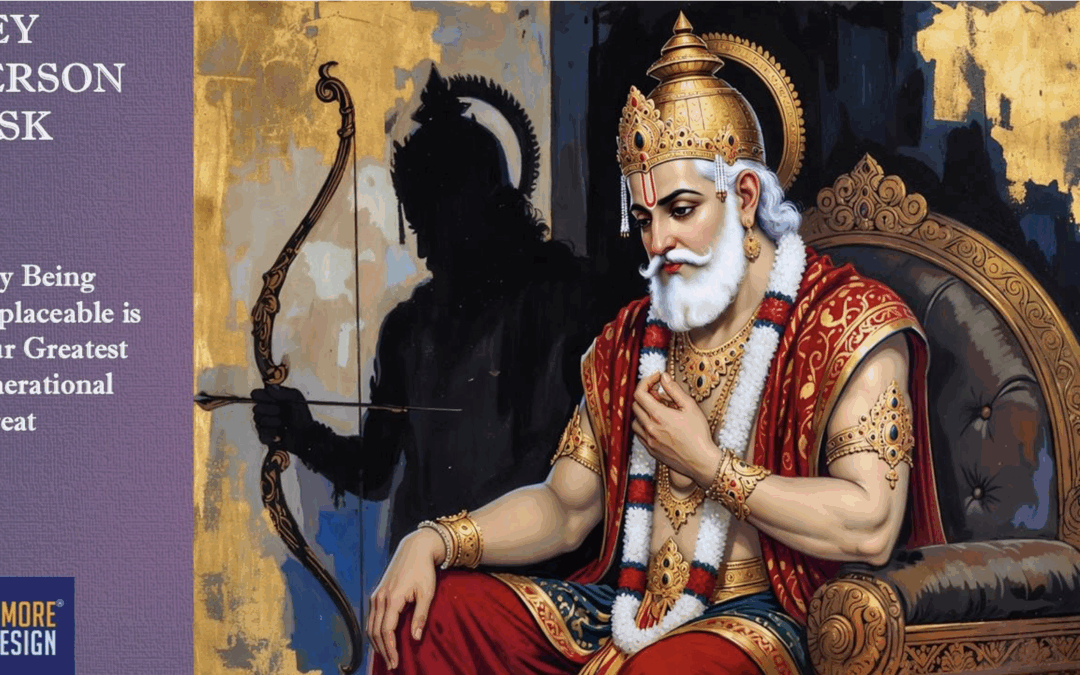
In the epic Ramayana, King Dasharatha of Ayodhya was a great ruler—powerful, beloved, and central to the stability of his kingdom. His very presence was the pillar of his empire. Yet, his story is a profound lesson in the danger of being irreplaceable. His emotional attachment and past promises, tied inextricably to his personal authority, led to a succession crisis that sent his rightful heir into exile and ultimately cost him his life. The kingdom, so dependent on him, was thrown into chaos.
This is the “Curse of Dasharatha” for the modern business founder: building an organization that is so dependent on your personal touch, your “gut feel,” and your singular authority that it cannot function smoothly without you. It is the ultimate form of Key Person Risk, and it is the greatest threat to the legacy you’ve spent a lifetime building.
Are You the Dasharatha of Your Business?
Ask yourself these piercing questions, inspired by the challenges faced in our epics:
- The Unwritten Raj Dharma (The Processes):What are the core principles and processes of your business “kingdom”? Are they written, understood, and systemic? Or do they exist only in your head, dispensed as verbal wisdom, forcing your successor to guess your intent?
- The Personal Boons (The Relationships):Which key relationships with clients, suppliers, or bankers are based on your personal “boons” or promises? Have you intentionally transitioned this relationship capital to your son or daughter, or will that loyalty vanish when you are no longer on the throne?
- The Court of Elders (The Old Guard):Will your long-serving, loyal team members respect the authority of your chosen successor? Or is their loyalty tied only to you? For a daughter stepping into this role, this challenge can be immense, facing a court accustomed to a patriarch’s rule. Without a formal, ‘Designed’ system of authority, she is left to fight political battles instead of leading the business.
- The Exile of Strategy (The Lack of Empowerment):Do you truly empower your successor with real decisions and authority now, or are they kept in a state of perpetual “exile” from the real strategic chambers, expected to one day magically be ready?
A business where the founder is the system is a fragile one. It is a kingdom built for one king, not a dynasty. As many Indian family business stories show, the transition from the first to the second generation is often the most perilous. According to a PwC Family Business Survey, only a small fraction of family businesses survive into the third generation, often because of succession challenges. (10th Global Family Business Survey – India report).
Breaking the Curse: From King to Kingmaker
The only way to ensure your legacy endures is to shift your role from King to Kingmaker. This means your final, greatest act of leadership is to make yourself progressively redundant.
- You must architect a ‘Designed’ system with clear processes (the new ‘Raj Dharma’).
- You must build a robust organizational structure (the ‘5 Pillars’) that distributes power and knowledge.
- You must use objective data from tools like the WMBD OPA [Link]to make decisions, creating a culture of transparency for your successor.
Don’t let your strength become your business’s fatal flaw. Avoid the Curse of Dasharatha. Build a kingdom so well-designed that it empowers its future rulers to lead with confidence and strength, securing a legacy that lasts for generations.
Is your business dangerously dependent on you? It is a critical risk that must be addressed before any transition. [Take the OPA Assessment – Link] to get an objective measure of your organization’s systemic strength, independent of any single leader.
#KeyPersonRisk #Succession #Ramayana #Legacy #FamilyBusiness #WinMoreByDesign