
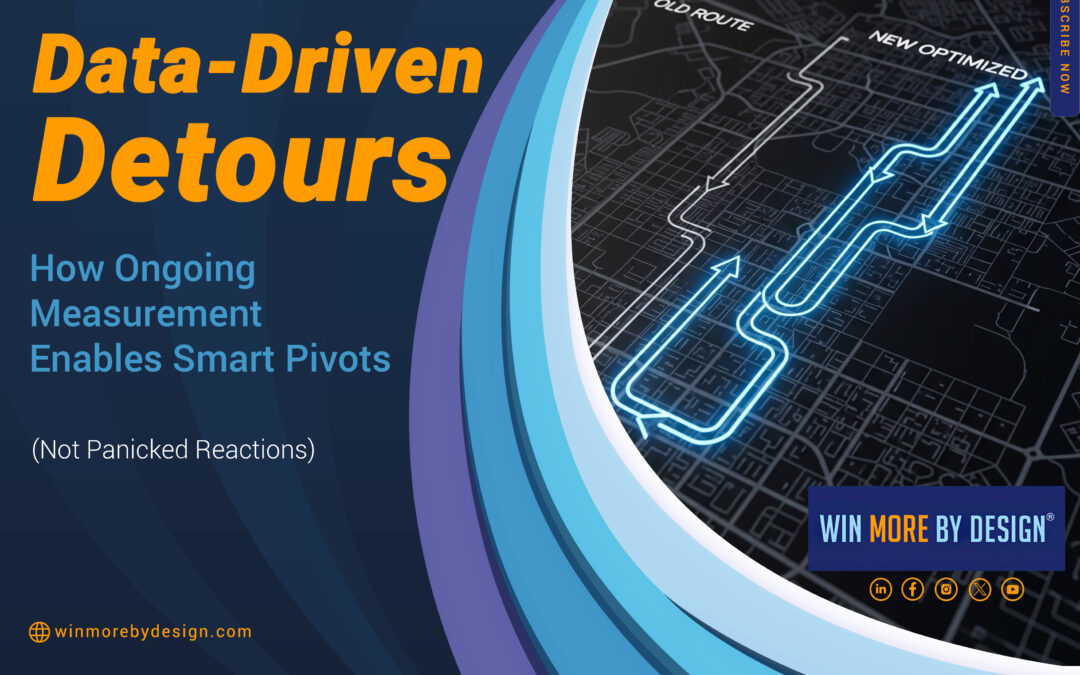
You’ve ‘Designed’ your business strategy. You’ve aligned your teams. You’re moving forward. But what happens when unexpected turbulence hits, or a new, lucrative opportunity appears on the horizon? If your reaction is panic or rigid adherence to the original plan, you’re likely missing out on critical opportunities to optimize and accelerate.
The key to navigating these moments successfully isn’t about having a perfect, unchangeable plan. It’s about having the data and the mechanisms to enable smart, informed pivots and course corrections. This is where ongoing measurement becomes your most valuable asset.
The Danger of ‘Set It and Forget It’ Strategy:
Many leaders create a strategy and then set it aside, only to pull it out again when results falter. This approach has critical flaws:
- Ignoring Early Warning Signs: Without continuous measurement, you won’t see the subtle shifts or early indicators that suggest a course correction is needed, allowing small issues to become major problems.
- Missed Opportunities: A rigid adherence to a plan can cause you to overlook emerging trends or customer needs that represent significant growth potential.
- Lack of Data for Pivots: When you do need to change course, without current data on performance, customer feedback, or market dynamics, your pivot is likely to be based on guesswork – a reactive swerve, not a calculated maneuver.
The Power of Ongoing Measurement & Feedback:
Integrating continuous measurement and feedback into your ‘Designed’ framework allows for:
- Early Detection of Deviations: Regularly monitoring KPIs (like those identified through the WMBD OPA https://winmorebydesign.com/opalink/ acts as your ‘navigation system,’ alerting you when performance drifts from the intended course.
- Informed Decision-Making: When you need to adjust, you have objective data on hand to understand why a change is needed and what might be the best alternative route. This allows for calculated pivots, not panicked reactions.
- Quantifying Impact of Changes: Measuring results after a course correction helps you learn what works, refine your approach, and continuously improve your strategic execution.
- Building an Agile Culture: When teams see that data is used constructively for improvement and adaptation, it fosters trust and encourages a culture of continuous learning and responsiveness. This is vital for long-term success, as highlighted by research on agile organizations (https://www.mckinsey.com/capabilities/people-and-organizational-performance/our-insights/the-journey-to-an-agile-organization).
WMBD: Your Partner in Navigational Intelligence
WMBD doesn’t just help you design your strategy; we help you build the ongoing mechanisms for monitoring, learning, and course correction. Our approach embeds data-driven insights into your daily operations, empowering you to navigate complexity with confidence and adapt proactively to ensure sustained growth and synergy.
Stop letting your strategy become outdated by inertia. Equip yourself with the data and processes to pivot intelligently and keep your business moving towards its highest potential.
Is your strategy built for the journey, or is it a rigid map that might lead you astray? Schedule a Strategic Course Correction Session with Arjun to discuss how to build agility into your design.
#CourseCorrection #Agility #DataDriven #ContinuousImprovement #Strategy #Adaptability #WinMoreByDesign