
I was reviewing an assessment last week. A CEO of a ₹200 crore manufacturing company. Great product, good market position. But he said something that made me pause: “Arjun, we keep hitting our targets, but it feels like we’re always one crisis away from missing them.”
That’s when I showed him the foundation analogy.
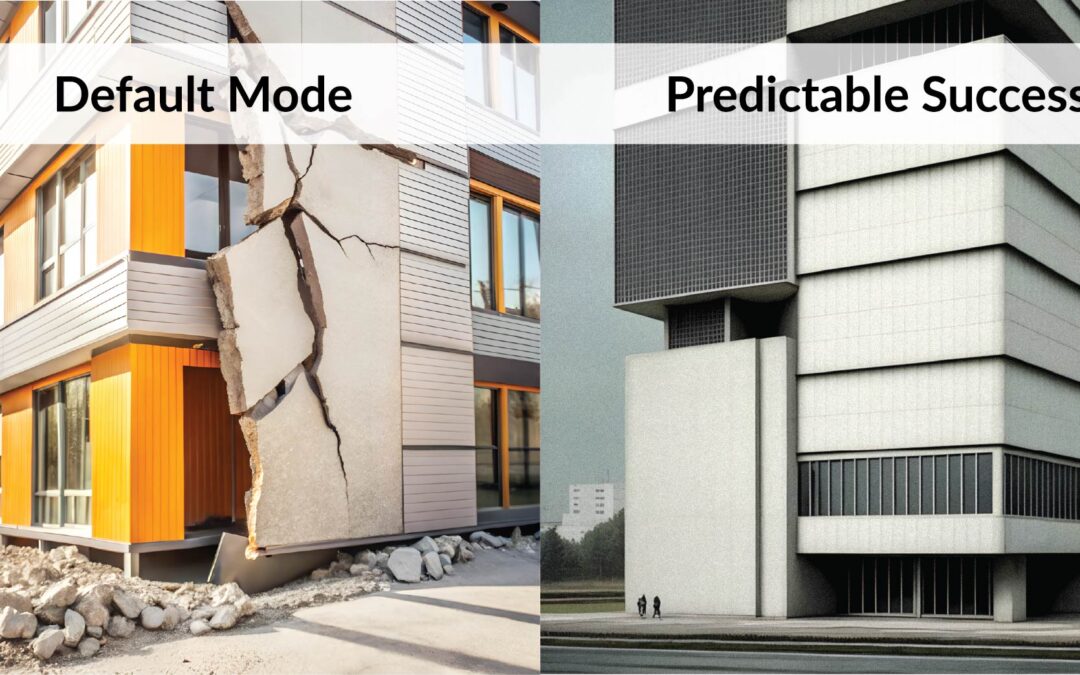
Most organisations today are building their success on quicksand. They’re reacting, hoping, firefighting. One quarter looks good, the next quarter they’re scrambling. They think they’re building a business, but they’re actually just managing chaos.
As I told him: “You can’t build a multi story building on quicksand. You need solid pillars. That’s what Win More By Design is all about – moving from quicksand to bedrock.”
After 27 years of working with 50+ organisations, I’ve identified the 5 non-negotiable pillars that separate organisations playing ‘Design’ from those stuck in ‘Default’. Missing even one of these pillars? You’re building on quicksand.
Recent research shows that organisations with data driven organisational objectives see measurably better performance, while misaligned metrics “significantly undermine organisational effectiveness by directing resources and efforts toward non-essential areas.”
Pillar 1: Organisational Goal Clarity (Your True North)
Do most CEOs think they have goal clarity? They necessarily don’t.
Real goal clarity isn’t “increase revenue by 15%.” That’s a target. Goal clarity is when every person in your organisation understands not just WHAT you’re achieving, but WHY and HOW their work contributes to it.
For example, we worked with a software company. The CEO thought everyone understood their goal: “Become the leading CRM in our segment.” But when we did our OPA, only 23% of employees could explain what that meant for their daily work.
The point is: Walk into your office right now. Ask any three employees: “What is the overall organisation objective, and how does your work contribute?” If they can’t answer clearly, your organisation as a collective unit doesn’t have the way forward clarity.
Pillar 2: Employee Goal Clarity (Individual GPS)
Organisational clarity is the destination. Employee clarity is the individual GPS.
This is where most organisations fail. They announce the big vision, but they never translate it down to “What does this mean for Raj in accounts? What does this mean for Priya in production?”
We call this the ‘iron filing to magnet’ transformation. Iron filings scattered randomly become aligned when you introduce a magnet. Understanding clearly of organisational strategic objectively is becoming a magnet.
How is your team’s performance measured against strategic objectives, or are they just measuring activities? Activities don’t create results. Aligned actions do.
Pillar 3: Milestone Tracking (Your Navigation System)
You can’t manage what you don’t measure. But most organisations are measuring the wrong things.
They track revenue, profit, expenses – all lagging indicators. By the time those numbers tell you something’s wrong, it’s too late to course-correct.
Real milestone tracking combines leading and lagging indicators. It’s like having both a fuel gauge AND a GPS in your car.
For example, a hardware company was tracking monthly revenue. Always seemed fine until suddenly they’d miss targets. Our OPA revealed the real leading indicator: actual customer face to face meeting time. When face to face time dropped, revenue would drop 6 weeks later. Now they course-correct immediately.
Are your key decisions based on real-time, relevant data or primarily gut feeling?
Pillar 4: Schedule and Planning (Your Strategic Calendar)
Most organisations confuse being busy with being strategic.
Schedule and planning isn’t about filling calendars. It’s about ensuring that time, resources, and energy are allocated to move your strategic objectives forward, not just react to the urgent.
We see this all the time – CEOs spending 80% of their time on operational issues and 20% on strategic work. That’s backward.
Look at your calendar for the past month. What percentage was spent on strategic initiatives vs. firefighting? If it’s less than 60% strategic, you’re in reactive mode.
Pillar 5: Execution Culture (Your Engine)
This is where the magic happens. Or where everything falls apart.
Execution culture isn’t about working harder. It’s about creating an environment where the right things get done consistently, without heroic efforts.
We call this the ‘stars to constellation’ transformation. You might have individual stars in your organisation, but do they work together as a constellation? That requires mutual purpose, mutual trust, and mutual respect.
The point is: One software product company manufacturer had brilliant individuals but poor execution. Projects took twice as long as planned. Our assessment revealed the issue: no accountability systems. People weren’t aligned on WHO does WHAT by WHEN. We fixed that. Project completion time improved by 47%.
Do you have regular, structured strategy review sessions built into your calendar? Or do strategic discussions only happen during crises?
Research from MIT Sloan Management Review shows that AI-enhanced KPIs are becoming critical for “strategic alignment across organisations” and that companies using smart KPIs gain “strategic differentiation and value creation.”³
Here’s what I’ve learned: Ignoring any of these pillars is choosing ‘Default’ mode. It’s choosing to build on quicksand, hoping the foundation holds.
Building ALL five pillars is choosing ‘Design’ mode. It’s choosing bedrock. Predictable success. Control over your destiny.
That hardware company I mentioned? Their OPA score went from 48% to 89% in 100 days. Same people, same market, same challenges. Moving from default to design made all the difference.
Which foundation is your organisation built on – default (quick sand) or design (bedrock)?
Do you understand the difference?
Ready to move from quicksand to bedrock? Take our OPA (Organisational Productivity Assessment) and discover which of your 5 pillars need immediate attention.